← Back to selected work

Population health · quantitative sociology · United States

Socioeconomic Stratification and Multimorbidity Across Adulthood

A reproducible quantitative health-sociology project using the 2024 National Health Interview Survey to examine how education and family poverty are associated with multimorbidity across stages of adulthood.

2024 NHIS32,629 Sample Adult respondentsRComplex survey analysisMultiple imputationSurvey-weighted regression

Research problem

Chronic-condition burden is not only age-patterned. It is socially patterned.

Multimorbidity is often presented as an aging problem, but chronic-condition accumulation also varies across socioeconomic position. The analytical challenge was to quantify education and poverty gradients while respecting the NHIS complex sample design and the CDC's multiply imputed income data.

The project asks how socioeconomic disadvantage is associated with multimorbidity among U.S. adults and whether the education gradient varies across adulthood.

Primary outcome: two or more of 12 chronic physical or mental health conditions. A physical-only definition is included as a sensitivity analysis.

Executive view

Multimorbidity is common, and socioeconomic gradients remain after adjustment.

37.7%Weighted multimorbidity prevalence
1.73Adjusted OR: <high school vs bachelor+
17ppApprox. education gap at ages 50–64
2.08Adjusted OR: <100% vs 400%+ FPL

Analytical architecture

A reproducible survey-statistics workflow from official microdata to defensible results.

01Download official CDC/NCHS public-use files
02Recode outcomes, socioeconomic measures and covariates
03Apply NHIS weights, strata and pseudo-PSUs
04Fit weighted models and pool 10 income imputations
05QA, sensitivity analysis and publication-style outputs

Findings

The socioeconomic gradient changes across adulthood.

01 / Education × age

Educational inequality was not constant across adulthood.

The joint interaction test was significant: F = 5.06, p < 0.001.
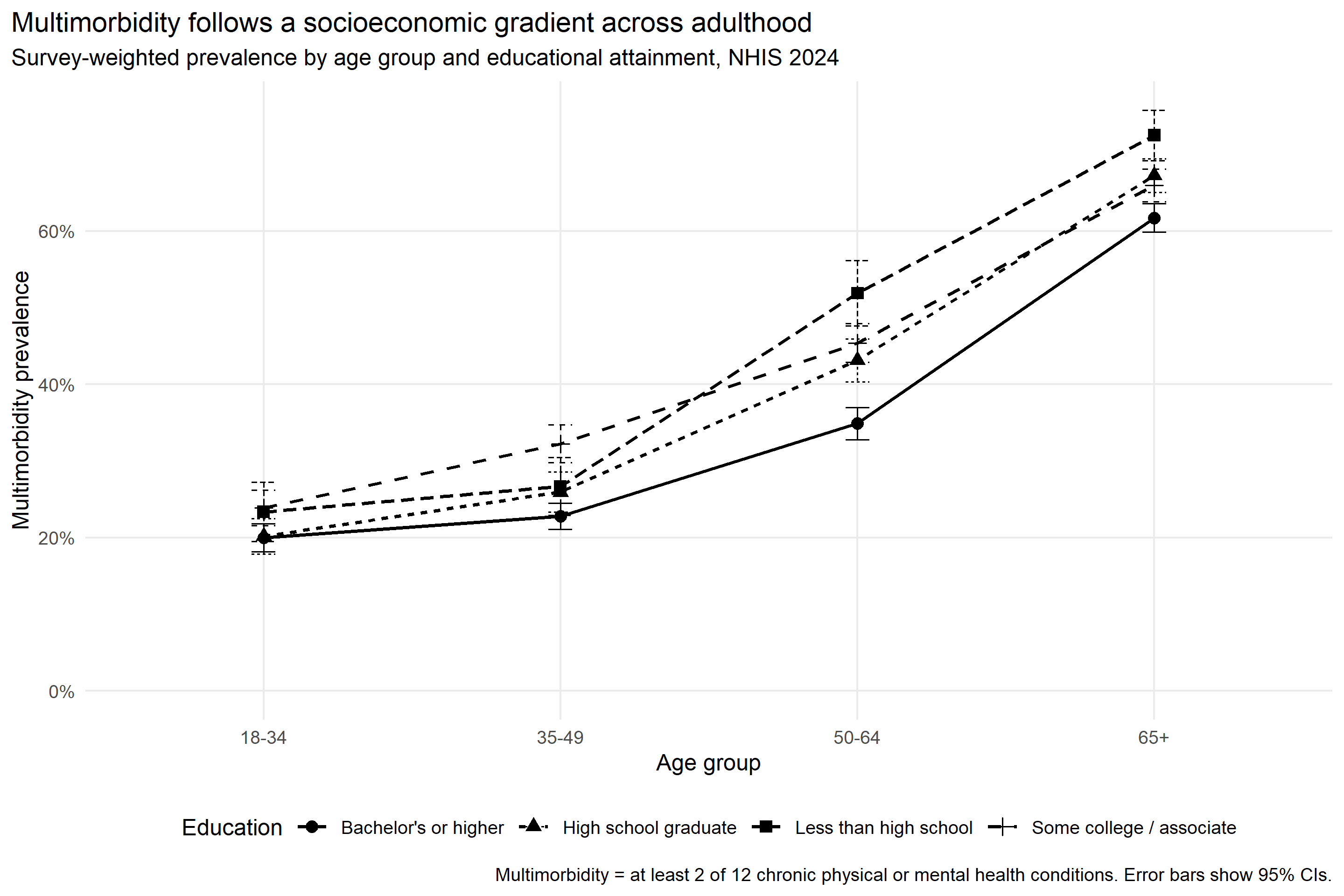
Multimorbidity prevalence by age group and educational attainment

Among adults aged 50–64, estimated prevalence was 51.9% for those with less than high school education and 34.9% for those with a bachelor's degree or higher.
02 / Condition profile

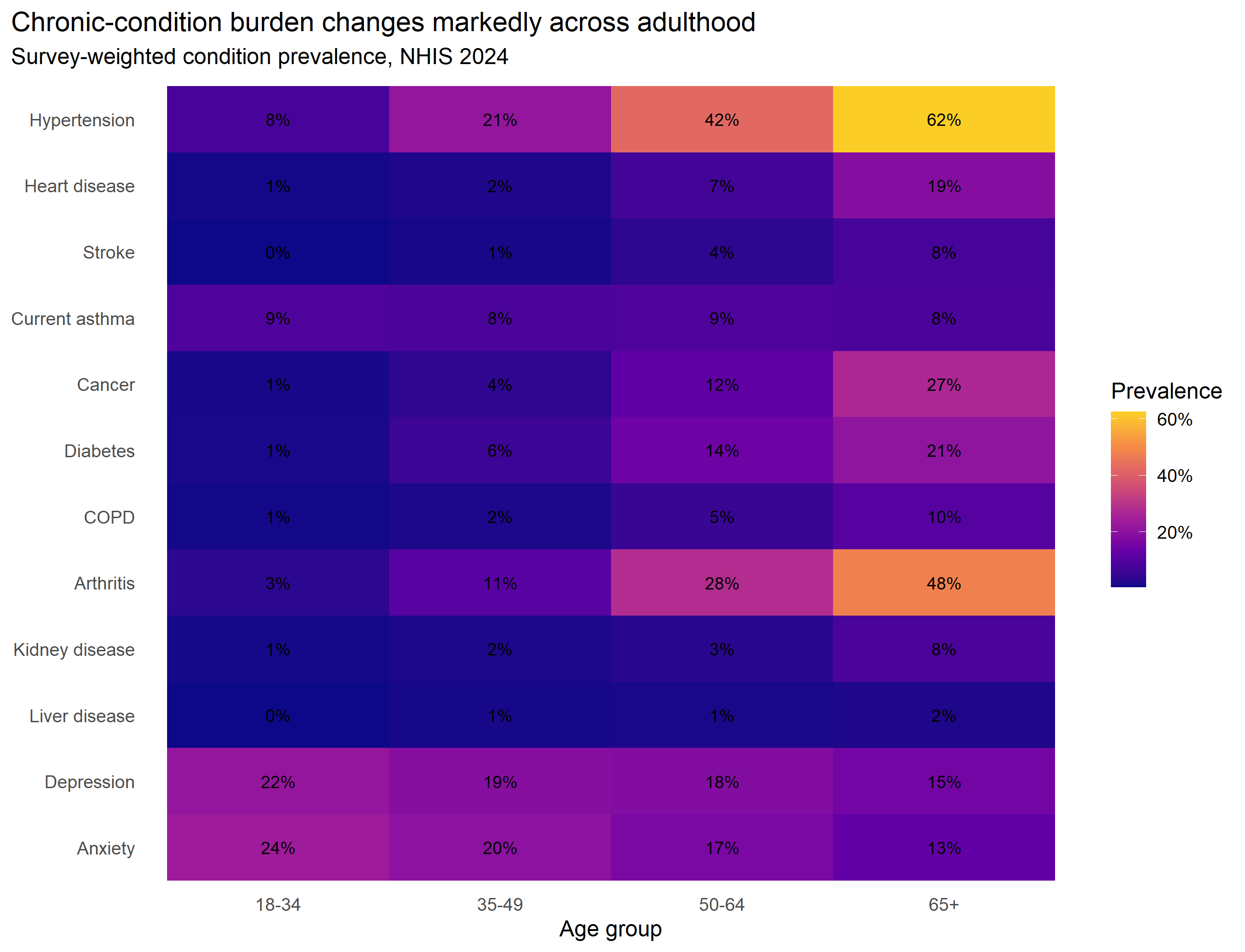
The composition of chronic-condition burden changes markedly with age.

Heatmap of chronic condition prevalence by age group

Hypertension, arthritis, cancer, diabetes and heart disease rose strongly with age, while diagnosed anxiety and depression were more prevalent in younger adults.

03 / Adjusted associations

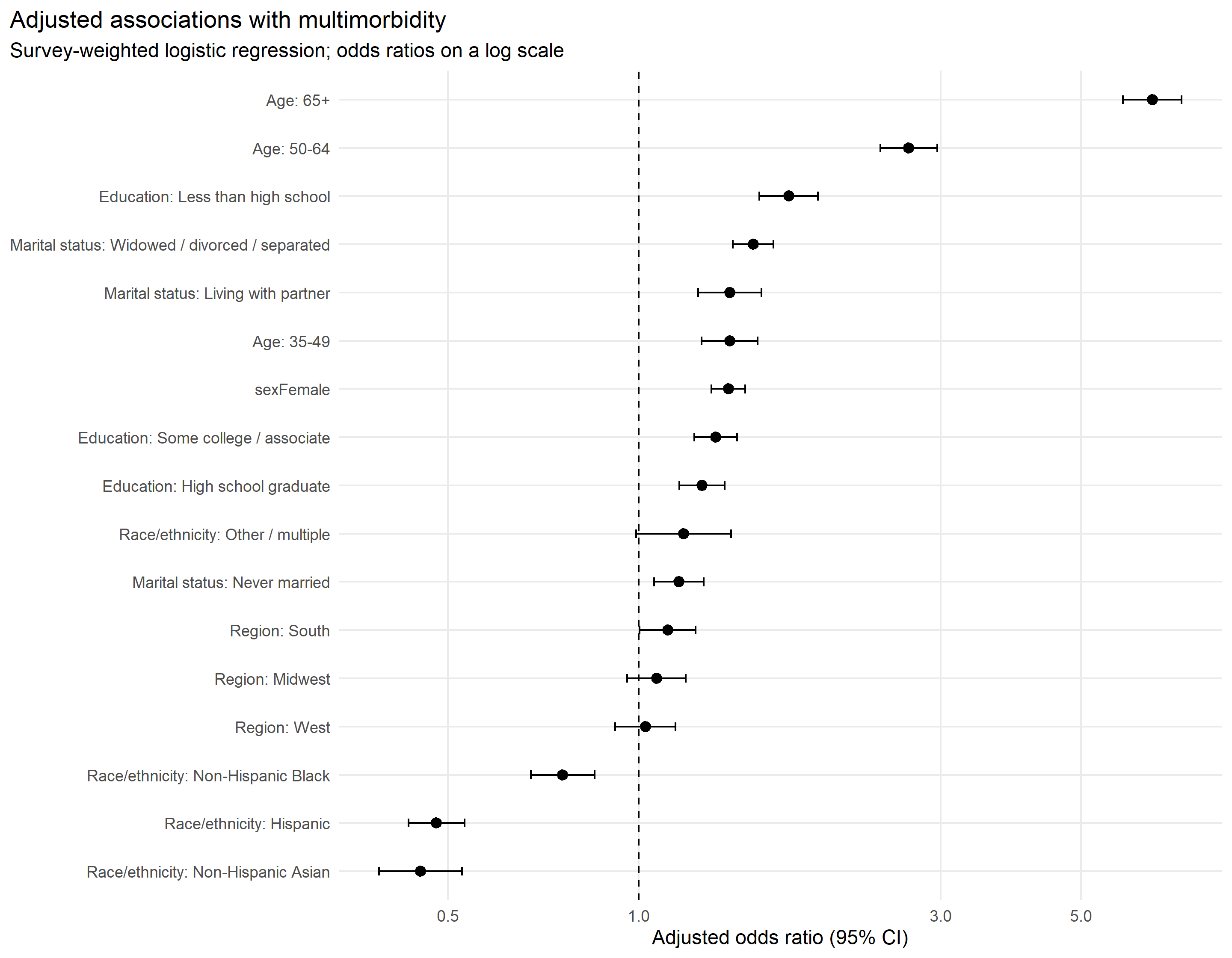
Education and family poverty retained substantial adjusted associations.

Adjusted odds ratios for multimorbidity

Adults with less than high school education had adjusted odds 1.73 times those with a bachelor's degree or higher. Adults below 100% of the federal poverty level had adjusted odds 2.08 times those at 400%+ FPL after pooling all 10 income imputations.

Methods & interpretation

Complex survey design and uncertainty are treated as part of the analysis.

The workflow uses the final annual Sample Adult weight, pseudo-PSU and pseudo-stratum; survey-weighted descriptive estimates; logistic and quasi-Poisson models; an education-by-age interaction; a physical-only sensitivity analysis; and Rubin's rules to pool the 10 CDC income imputations.

The study is cross-sectional. Results are associations, not causal effects or within-person life-course trajectories. Odds ratios are not interpreted as risk ratios, and race/ethnicity coefficients are treated as descriptive adjusted associations rather than biological effects.

Inspect the work

The full R workflow is public and reproducible.

The repository contains the analysis plan, variable dictionary, reproducibility notes, QA logs, machine-readable result tables, figures and the complete R pipeline.